“What’s Your Greatest Achievement?” How to Answer It and Get Hired
It sounds like the easiest question in the interview. You’ve done things. You’re proud of some of them. Just pick one and talk about it, right?
Not quite. Most candidates either freeze, ramble about something irrelevant, or undersell themselves so badly that the interviewer has forgotten the answer before they’ve finished writing their notes.
Here’s what surprises most people: this question isn’t really about your achievement at all.
What the Interviewer Is Really Asking
I’m Joe McDermott, a career and interview coach. Over the past 20 years I’ve helped thousands of people land great new jobs, and I’ve sat on hundreds of interview panels helping companies recruit. So I can tell you exactly what’s going through the interviewer’s mind when they ask this question:
“What have you done before that will benefit us?”
Or put another way: “What experience are you bringing that’s useful to this company?*
Keep that hidden question in mind. It’s the difference between an answer that wins the job and one that’s just words the panel forgets by the next candidate.
By the end of this post, you’ll have a complete, repeatable framework for answering this question. It works whether you’ve got a dozen big wins on your CV or you’re early in your career and worried you don’t have a “big” story at all.
Example of a Real Answer That Didn’t Get the Job
I was recently on a panel recruiting for a junior marketing role. Here’s how one candidate answered:
“My greatest achievement? I would say it’s probably graduating college while working part-time. It was really hard balancing everything, but I pushed through and got my degree. I’m proud of that. There were a lot of late nights and I almost gave up a few times, but I just kept telling myself to stay focused. Looking back, I think it really shows that I’m a hard worker and I don’t give up easily, which I think would be helpful here.”
On the surface, it’s not a terrible answer. It shows hard work, determination, and some enthusiasm. But they didn’t get the job, and there were three reasons why.
- It wasn’t relevant enough. Graduating college says nothing about running marketing campaigns or managing projects. As a panel, we’d much rather have heard about something from their work experience.
- There was no measurable outcome. “It was really hard” and “I pushed through” are feelings, not evidence. Compare “I worked hard” with “I raised my GPA from 2.9 to 3.8 while working 25 hours a week.” The second one sticks.
- It was passive.This is a story about surviving something. That’s fine, but it doesn’t show any value being created. Great answers show you *driving* a result, not just getting through a hard time.
And here’s the thing: that story isn’t actually a bad choice. It’s just told badly. So let’s look at how to tell it well.
Introducing The WON Framework
I call my three-part approach The WON framework, because winning is literally what it’s designed to do. It works brilliantly at any career level.
- W is for Wins. Open with three or four high-level achievements to show your range.
- O is for One. Go deep on one highly relevant story, the strongest item from your list, told with real enthusiasm.
- N is for Next Steps. Tell them exactly how you’ll use that experience to benefit *them*.
Let’s walk through each part with example answers you can adapt.
Part 1: Wins — Sell Yourself First
Before you get to your single greatest achievement, open with a quick snapshot of your track record.
This is a powerful sales tool, and most candidates skip it. When you only mention one achievement, the interviewer is left wondering, *”Okay… is that all you can do?”* A short list of three or four wins signals that you’re not a one-hit wonder.
Keep it to 20–30 seconds. Here’s an example based on our marketing candidate:
“Over the past three years working in marketing since graduating, I’ve had the chance to drive some results I’m really proud of. I supported a rebrand campaign that increased social engagement by 65%, I managed a $200K paid ads budget and cut cost-per-acquisition by 30%, and I built an influencer partnership program from scratch that brought in 12 new brand deals in its first year.”
That’s three solid achievements, all relevant to the role, and each one shows a different skill: campaign execution, financial discipline, and building something new from the ground up.
Two things make a big difference here.
- Use numbers to show the size of your achievements. 65% engagement, 30% cost reduction, 12 new deals: that’s what makes the answer memorable. Three focused wins with real numbers will always beat five vague ones.
- Build your list in advance. Write down every “I did X, which led to Y” moment from the last two or three years. Look for percentages improved, money saved, time saved, people helped, and problems solved.
Part 2: One — Go Deep on Your Most Relevant Achievement
Now for the main event. The achievement you expand on should be the strongest, most relevant item from your Wins list, not a brand-new story. Choose the one that most closely mirrors what this specific job needs.
Structure it as Setup → Action → Result. Here’s the influencer program built out in full:
“The achievement I’m most proud of is building our influencer partnership program from scratch, and I mention it because it’s the clearest example of how I take an idea from zero to a working system, which I know is a big part of this role.
When I joined, we had no influencer strategy at all: no outreach process, no way to track performance, nothing. So I built it from the ground up. I researched and shortlisted micro-influencers aligned with our brand values, created a standardized outreach and negotiation template to speed up deal-making, and set up a simple tracking sheet to measure engagement and conversion for each partnership so we could double down on what worked.
In the first year, the program brought in 12 new brand deals, and the top three partnerships alone drove a 20% lift in traffic to our site. But what I really walked away with wasn’t just the deals. It was a repeatable playbook the team still uses to vet and onboard new partners today.”
What makes this land is a real starting point (no strategy, no process, starting from zero), specific actions (shortlisting, an outreach template, a tracking system, rather than a vague “I built relationships”), and a measurable result (12 new deals and a 20% traffic lift).
Spoken aloud, that’s 60–90 seconds. And notice: the difference between this and simply saying “I built an influencer program” isn’t a bigger achievement. It’s structure.
Part 3: Next Steps — Connect It to Their Needs
Don’t finish your story and go quiet. Finish strong by connecting it directly to the role and showing how your experience will benefit them.
For example:
“That experience is a big part of why I’m excited about this role specifically. I saw in the job posting that you’re looking to grow owned channels and reduce your dependency on paid acquisition, and that’s almost exactly the challenge I solved in my last role. I’d bring the same approach here: find the channel that’s underperforming or untracked, build a system around it with real measurement, and hand over something that keeps producing results long after the initial project wraps up.”
Here’s how to adapt this to your own role: pick one key thing they want the new hire to do. You’ll usually find it in the job description, or in a recent news article about the company. It only needs to be one concrete detail, but it has to be real, not generic. “I saw you’re expanding into X, and here’s how I’d help you do that” is exactly the kind of line that works.
This step matters because you’re doing the interviewer’s job for them. Instead of making them guess how your achievement relates to their problem, you’re connecting the dots out loud.
Putting It All Together
To recap the WON framework: start with Wins, three or four achievements delivered quickly with a result attached to each. Then go into One detailed story, the strongest and most relevant item from your list, told as Setup → Action → Result. Finish with Next Steps, bridging forward with one specific detail from the job posting or company and showing how you’ll apply what you’ve just described.
Aim for 90 seconds to two minutes out loud.
One delivery tip: don’t memorize your answer word for word. Memorize the *structure* (wins, one detailed story, next steps) and let the wording change naturally each time. Scripted answers sound scripted. Structured answers sound confident.
The Full Sample Answer
Here’s the complete answer, ready for you to adapt to your own role:
“Over the past three years working in marketing since graduating, I’ve had the chance to drive some results I’m really proud of. I supported a rebrand campaign that increased social engagement by 65%, I managed a $200K paid ads budget and cut cost-per-acquisition by 30%, and I built an influencer partnership program from scratch that brought in 12 new brand deals in its first year.
The achievement I’m most proud of is that influencer program, because it’s the clearest example of how I take an idea from zero to a working system. When I joined, we had no influencer strategy at all: no outreach process, no way to track performance. So I researched and shortlisted micro-influencers aligned with our brand values, created a standardized outreach and negotiation template, and set up a tracking sheet to measure engagement and conversion for each partnership. In the first year, that brought in 12 new brand deals, and the top three partnerships alone drove a 20% lift in site traffic. Just as importantly, it left the team with a repeatable playbook they still use today.
That’s a big part of why I’m excited about this role. I saw in the job posting that you’re looking to grow owned channels and reduce dependency on paid acquisition, which is very close to the challenge I solved in my last role. I’d bring the same approach here: find the channel that’s underperforming or untracked, build a system around it with real measurement, and create something that keeps delivering results long after the initial project is done.”
Win the Room
A brilliant answer to this question can put you well ahead of the other candidates. So before your next interview, write out your own version using the WON framework, say it out loud, and time it.
You don’t need the most impressive achievement in the room. You need the most relevant one, told with real structure. Do that, and this question stops being the one you dread and becomes the moment you *won* the room, before they’ve even asked the next question.
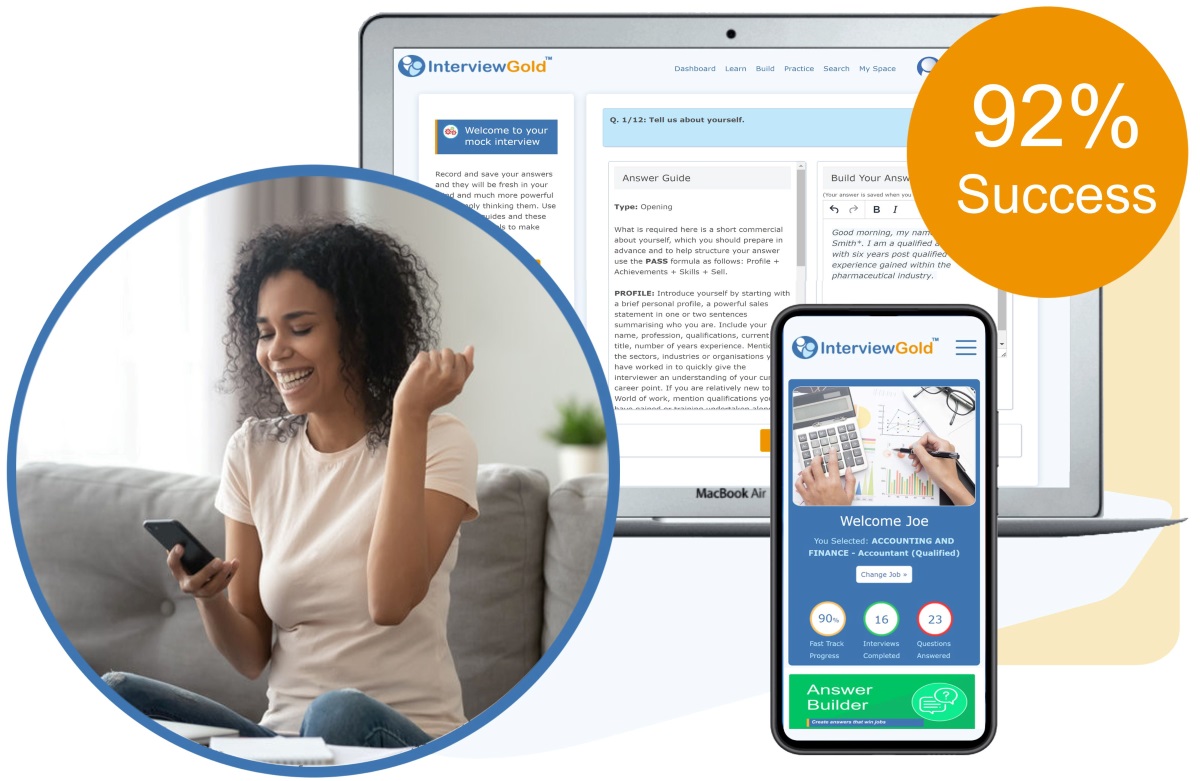
Answer Any Job Interview Question Perfectly With InterviewGold
Answering the tell me about yourself interview question perfectly is a skill, but one you can learn. It is like an elevator pitch and you should have it clear, polished and smooth.
With our easy online interview platform you will get expert answers to any interview or application question in minutes. Personalised to you, you will know what to say to get your target job. Plus you get accurate questions most likely to arise and expert advice from our interview coaches.
Best of all, it is tailored to your job, log in enter your target job and employer, select your sector and get accurate questions and answers plus tons of top advice. Over 20 sectors are covered including Accounting, Finance, Customer Services, Banking, Marketing, Sales etc.