How to answer “What Are Your Weaknesses?”+ Best Sample Answers to Avoid Red Flags.
(And Why This One Question Loses More Job Offers Than Any Other)
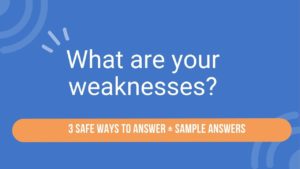
In this article, I am going to show you the three best and safest ways to answer the weakness interview question. It can be phrased as:
“What are your weaknesses?”
“What is your greatest weakness?”
“What is your biggest weakness?”
These questions sounds simple. Harmless. Even fair. But in reality, they are the most dangerous interview questions you will ever face.
Not because candidates answer it badly. But because they answer it honestly — and strategically wrong.
Over the past 20 years, I’ve coached thousands of candidates into top jobs across the UK and internationally. I’ve also sat on interview panels reviewing hundreds of applicants. And I can tell you this with certainty:
This question quietly destroys strong candidates every single day.
Despite being such a common question with lots of advice online, many candidates still struggle to give an effective answer. So, how do you answer it effectively while at the same time making sure you don’t give something away which would give your prospective employer a reason not to hire you?
In this guide, I’ll show you:
- Why “What Are Your Weaknesses?” Is So Dangerous
- A Real Life Example From My Coaching
- The 4 Biggest Traps That Lose Job Offers
- What Interviewers Are Actually Testing
- 3 Best and Safest Ways to Answer to “What Are Your Weaknesses?”
- High-Scoring “What Are Your Weaknesses?” Sample Answer
- What NOT to Say – Mistakes to Avoid When Answering About Weaknesses
- Final Recap – 7 Golden Rules to Answer What Are Your Weaknesses?
- How to Get Your Target Job Faster With InterviewGold
Why “What Are Your Weaknesses?” Is So Dangerous
On the surface, the question feels reflective. Balanced. Reasonable.
But here’s what most candidates miss:
This question is not about your weakness.
It’s about your judgment, self-awareness, and risk level.
Candidates often respond emotionally instead of strategically. They:
- Panic
- Over-explain
- Confess
- Try to be clever
- Overshare
None of that helps.
When interviewers ask this question, they’re thinking:
- Can I trust this person’s self-assessment?
- Do they understand how performance works?
- Will they create problems I’ll have to manage?
- Are they coachable — without being fragile?
This is not a confession booth.
It’s a professional risk assessment.
Once you understand that, everything changes.
A Real Life Example From My Coaching

Let me give you a real example.
A candidate I coached recently said:
“I take on too much work, but that’s ok — I like to work lots of overtime.”
They thought it sounded dedicated and hardworking.
But here’s what an interview panel is really thinking:
- This candidate is inefficient.
- They can’t manage workload properly.
- They’re at risk of burnout.
- Hiring them could create problems.
And just like that — no job offer.
The 4 Biggest Traps That Lose Job Offers
Let’s break down the four “bear traps” that catch even experienced professionals.
Trap 1: The Fatal Flaw
This is when candidates say:
- “I struggle with confidence.”
- “I’m not very organised.”
- “I’m a poor communicator.”
- “Deadlines stress me out.”
The problem?
You’ve just described why they shouldn’t hire you.
That’s not admirable honesty. That’s a red flag.
Interviewers immediately think:
“How much management is this person going to need?”
You’ve increased perceived risk.
The fatal flaw answer is the quickest way to lose credibility. When you admit to weaknesses that are core to the role — like poor organisation, weak communication, or struggling under pressure — you create immediate doubt.
Interviewers aren’t rewarding honesty; they’re assessing risk. You’ve just given them a reason not to hire you.
Trap 2: The Fake Strength
You’ve heard these before:
- “I’m a perfectionist.”
- “I work too hard.”
- “I care too much.”
Interviewers switch off instantly.
Why?
Because it signals:
- Low self-awareness
- Rehearsed nonsense
- Poor credibility
It tells them you don’t understand the question.
The fake strength answer damages credibility instantly. When candidates say things like “I’m a perfectionist” or “I work too hard,” interviewers hear avoidance, not insight.
It suggests low self-awareness or rehearsed responses. Instead of sounding impressive, you signal that you haven’t understood the purpose of the question.
Trap 3: The Uncontrolled Weakness
This one sounds reasonable — but still fails:
“I struggle with delegation, but I’m working on it.”
Working on it how?
Where’s the evidence?
What’s the result?
An uncontrolled weakness sounds responsible but still creates doubt. When candidates say they are “working on” something without clear evidence of improvement, interviewers hear risk.
If the issue feels ongoing, unmanaged, or measurable in the role, it raises concerns about performance and the level of supervision required.
Trap 4: The Over-Confessional
This catches experienced professionals more than anyone else.
They overshare:
- Career regrets
- Personal struggles
- Emotional journeys
- Deep self-analysis
The over-confessional answer often comes from good intentions. Candidates want to show depth, authenticity, and reflection — so they open up.
They talk about burnout, failed promotions, difficult bosses, anxiety, imposter syndrome, or personal setbacks. The problem is not vulnerability itself. The problem is context. An interview is a hiring decision, not a coaching session.
When you go too deep, you shift the focus from capability to concern. The panel starts thinking about stability, resilience, or potential future issues. Even if your story ends positively, the doubt has already been planted. In interviews, clarity builds confidence — but oversharing creates uncertainty.
What Interviewers Are Actually Testing
When they ask “What are your weaknesses?” or for your greatest weakness, they are not looking for drama. They are assessing risk.
There are two key things they are testing:
1️⃣ Do You Have Any Serious Shortcomings?
They want to know:
Is there anything here that would prevent this person from doing the job competently?
Recruitment is expensive. Hiring the wrong person is risky.
They are asking: “Is this person safe to hire?”
2️⃣ Are You Self-Aware?
No one is perfect.
Good candidates recognise areas for development and take action to improve.
So your answer must:
-
Give reassurance
-
Show self-awareness
-
Demonstrate continuous improvement
3 Best and Safest Ways to Answer to “What Are Your Weaknesses?”
Now let’s look at the three best ways to answer safely while giving reassurance to the employer.
✅ BEST ANSWER #1: Admit Nothing (The Reframe Method)
This approach is not about dodging the question.
It’s about reframing it.
Instead of handing over a flaw for analysis, you anchor the conversation in capability. You don’t confess. You reassure.
Sample Answer:
“I’ve taken time to carefully review the responsibilities of this role and the outcomes you’re looking to deliver over the next 12–18 months. Based on my experience leading similar projects, managing stakeholders, and delivering measurable results, I’m confident my skills position me to deliver effectively from the outset.
I can hit the ground running from day one.
Of course, like any professional, I continue to refine my skills. However, there is nothing in the core requirements of this role that I feel unprepared for. I’m confident I can add value quickly and contribute effectively.”
In other words:
- Yes, I can do the job.
- Yes, I am ready.
- No, there is no capability gap that puts this role at risk.
Why This Works
- No over-explaining
- No scrambling
- No nervous rambling
- No risky admission
This strategy works best when:
- You are genuinely well-qualified
- Your CV clearly aligns with the role
Close the door professionally. Move on.
🥇 BEST ANSWER #2: The Past Improvement Method
If you prefer to give a traditional response, this is a safe and powerful structure.
The Formula:
-
Choose a real weakness from your past
-
Show how you addressed it
-
Prove it is now resolved
But be careful.
The weakness must NOT be:
- A core skill
- A key requirement
- Central to the role
Choose something helpful but not essential.
Sample Answer:
“Earlier in my career, I struggled with delegating. I tended to take on too much myself because I wanted to maintain high standards. While that meant tasks were completed thoroughly, I realised it limited the development of others and wasn’t sustainable.
I completed training on effective delegation and introduced a structured approach — agreeing responsibilities clearly, setting expectations, and building trust within the team.
As a result, productivity improved and team confidence increased. I still care deeply about quality, but I now focus on empowering others rather than doing everything myself.”
Why This Works
- Shows insight
- Demonstrates action
- Proves growth
- Ends positively
This approach works brilliantly for:
- Managers
- Team leaders
- Professionals at any level
The key is this:
It must be sorted.
You are not bringing the weakness into the new job.
🚀 BEST ANSWER #3: The Future-Focus Method
This is ideal for:
-
Junior candidates
-
Entry-level applicants
-
Career changers
You acknowledge an area of development — then show rapid learning and link it to value.
Sample Answer:
“One area I’m continuing to develop is advanced data visualisation tools. I’m confident using Excel and reporting dashboards, and I’ve used these extensively over the past three years to track performance metrics and present insights to stakeholders.
However, I recognised that tools such as Power BI can enhance how complex data is communicated. I’ve recently begun formal training and have applied this knowledge in internal projects to build more dynamic reports.
My aim is not just to analyse data accurately, but to present it in a way that supports faster decision-making. I see this as a positive development area that will increase the value I bring to this role.”
Notice What Happens Here
- A gap is acknowledged
- Proactive action is shown
- It links directly to the job
- It ends on added value
The interviewer is not worried.
They’re thinking forward.
High-Scoring “What Are Your Weaknesses?” Sample Answer
Here’s a strong example you can adapt:
“Having studies the job description and knowing your company and what you need, I can state that I am confident I can take ion the role and perform effectively and brilliantly.
I don’t have any weakness that will affect my ability to do that successfully.
However, I do recognise the need to develop and grow. Earlier in my career, one area I had to work on was how quickly I stepped in to solve problems myself.
I noticed that while it helped short-term delivery, it sometimes limited others’ development.To address this, I became more deliberate about stepping back — asking better questions, setting clearer expectations, and agreeing check-in points rather than jumping in immediately.
As a result, I’ve seen stronger ownership from team members, better long-term capability, and improved overall performance — while still maintaining delivery standards.”
Why this works:
- It’s real
- It’s not role-critical
- It shows maturity
- It reduces hiring risk
And reducing risk is how job offers are won.
🚫 What NOT to Say – Mistakes to Avoid When Answering About Weaknesses
Using false weaknesses: For example, “I get so involved in my work that I rarely take a break.” This would only indicate that you are in fact inefficient.
Mention a critical skill: For example: “I am not a people person.” Not a good answer if your job is managing or dealing with others. Might be ok, if you were a software developer working in a remote location.
Confessing all: You are in control in the interview and you can choose what to say. Don’t be tempted to gush all your failings as it will guarantee losing the job.
Final Recap – 7 Golden Rules to Answer What Are Your Weaknesses?
Follow these guidelines to give a strong answer to this question:
Be prepared in advance: Think about your weaknesses along with your strengths before going to an interview. Think of your weaknesses as development opportunities; something that hasn’t turned into strength yet.
Pick a weakness that it is not vital to the role: Your research will inform this. For example, you could talk yourself out of a job if you say that your people skills are in need of development if the role is in a direct customer facing role.
Put it in the past: We find that its best to mention something which you experienced in the past and which you are working to overcome or have in fact already overcome it.
Don’t focus on the negative: Keep your answer brief. In just a few words mention what your development opportunity is and then focus your answer on how you overcame it and how this is now a strength.
Describe a situation: Give an example and provide a solution at the same time. Choose something which is not critical: If you mention something which is ‘Essential’ to the role you may damage your chances.
Show you are learning: Emphasis that you are learning and if a certain thing is a shortcoming at the moment, it will show the hiring manager your willingness to constantly improve and learn.
Be brief in your response: This gives you less scope to elaborate too much and say something that will put the interviewer off.
How do you answer it effectively without sounding false or risking giving away a lack of a vital skill? You don’t want to give your prospective employer a reason not to hire you.
The main difficulty with this interview question is that you have just spent the first part of the interview selling yourself and trying to convince your interviewer that you are fantastic. Your instinct is to keep your faults well concealed.
How to Get Your Target Job Faster With InterviewGold
If you struggle with interviews and knowing exactly what to say, consider using the InterviewGold Answer Builder to generate tailored, high-scoring answers based on your CV and target job.
Your weakness answer should never cost you the job.
Now you know how to make sure it doesn’t.