Got an interview for a Nurse Associate post coming up in the NHS and wondering what questions they will ask?
In this article we take you through the top 12 most common Nurse Associate interview questions and we show you how to answer. Plus you get a short sample answers to get you started.
Nurse Associate Interviews – What to Expect
As a Nurse Associate in the NHS, you will play a vital role in delivering person-centred care and supporting registered nurses across a variety of healthcare settings.
You should expect interview questions which focus on these key areas and the core responsibilities of the post. These include monitoring patient health, taking observations, administering basic care, updating patient records, and assisting with clinical duties under supervision and
In your role, you will act as a bridge between healthcare assistants and registered nurses and you will help enhance patient outcomes. You will be on hand to help provide continuity of care and to deliver compassionate, quality healthcare services.
In your interview, you should expect both traditional and competency based interview questions exploring your experience, skills and motivation. They will assess how well able you are to provide safe and effective patient care and to contribute to care planning.
12 Nurse Associate Band 4 Interview Questions Listed
- Can you describe your understanding of the Nurse Associate role within the NHS?
- Talk us through your understanding of the 6 Cs in Nursing and give a recent example to illustrate this.
- How would you prioritise tasks during a busy shift on this ward?
- Give an example of how you maintained patient dignity in a healthcare setting.
- Imagine you are presented with a situation where you’re unsure of what to do. What actions would you take? What would be most important for you to consider?
- Tell us about a time you worked as part of a multidisciplinary team. What did you learn from the experience?
- What steps do you take to ensure patient safety at all times?
- Describe a time you used your communication skills successfully to deal with a challenging patient or family member.
- How do you ensure your own professional development as a Nurse Associate?
- How do you handle confidential patient information?
- What would you do if you saw a colleague not following proper procedures?
- In summary, what characteristic do you bring which will help you be an effective Nursing Associate?
See below for how to answer.
Nurse Associate interview Questions With Answers
1. Can you describe your understanding of the Nurse Associate role within the NHS?
How to Answer: Explain how the Nurse Associate bridges the gap between healthcare assistants and registered nurses. Mention duties like monitoring patients, supporting care plans, and delivering safe, compassionate care under supervision.
Sample Answer Excerpt: “The Nurse Associate role plays a vital part in delivering hands-on care, supporting registered nurses by performing clinical tasks such as wound care, observations, and documentation. We ensure continuity of care, improve patient experience, and contribute to multidisciplinary teamwork, all while upholding NHS values.”
Learn More: Get a full answer TAILOR MADE for you with our powerful Answer Builder.
2. Talk us through your understanding of the 6 Cs in Nursing and give a recent example to illustrate this.
How to Answer: The 6 Cs in nursing—Care, Compassion, Competence, Communication, Courage, and Commitment—are the core values that underpin high-quality care in the NHS. In your answer, explain each briefly, highlighting how they work together to improve patient outcomes. Then, provide a real-life example that shows how you demonstrated at least three of these values during your practice. The focus should be on patient-centred care, teamwork, professionalism, and ethical decision-making. Emphasise how your actions reflected these values and how they impacted the patient’s wellbeing or experience. Keep your example recent and relevant to the Nurse Associate role or clinical setting.
Sample Answer Excerpt: “The 6Cs in nursing guide everything we do. Care is at the heart of what we provide, while compassion ensures patients feel respected and understood. Competence means delivering safe, evidence-based care. Communication builds trust, courage supports ethical decisions, and commitment drives continuous improvement.
Recently, I cared for an elderly patient who was anxious about a new diagnosis. I took time to listen, reassured him using clear, empathetic language, and involved the family in care planning. This demonstrated compassion, communication, and commitment. The patient later shared how much more confident and supported he felt, which highlighted the true impact of the 6 Cs in action.“
Learn More: Get a full answer TAILOR MADE for you with our powerful Answer Builder.
3. How would you prioritise tasks during a busy shift on this ward?
How to Answer: In your answer, demonstrate awareness of clinical urgency, time management, and patient safety. Mention communication and teamwork. Refer to the techniques and strategies you have learned during you training and previous work experience. For example, Clinical Urgency First where you prioritise based on the severity of patient needs (e.g. pain, vital signs, risk of deterioration). Perhaps you use tools like NEWS2 (National Early Warning Score) to guide urgency. The common ABCDE Approach to Assess patients using Airway, Breathing, Circulation, Disability, Exposure—a fast, structured way to spot serious issues.
Sample Answer Excerpt: “I prioritise by assessing patient needs—those with deteriorating conditions or medication needs come first. I use handover notes, communicate with the team, and remain flexible to adapt to changing situations, ensuring all tasks are completed safely and efficiently. Let me talk through my experience in more detail and give you some examples….”
Learn More: Get a full answer TAILOR MADE for you with our powerful Answer Builder.
4. Give an example of how you maintained patient dignity in a healthcare setting.
How to Answer: Focus on respect, communication, and empathy. Highlight a specific action you took and use the STAR formula to structure your answer.
Sample Answer Excerpt: “In my recent post with St Georges, I supported a patient who felt embarrassed during personal care. They had never visited a hospital before and I could see that they were very nervous. Here are the actions I took to ensure their dignity was maintained at all times.
Firstly, I closed the curtains to give privacy. I explained every step, and ensured they felt in control. This helped build trust and maintained their dignity throughout. Next step….”
Learn More: Get a full answer TAILOR MADE for you with our powerful Answer Builder.
5. Imagine you are presented with a situation where you’re unsure of what to do. What actions would you take? What would be most important for you to consider?
How to Answer: Show your awareness of boundaries, willingness to seek help, and commitment to safe practice.
Sample Answer Excerpt: “If I were presented with a situation where I wasn’t sure what to do, my first priority would be patient safety. I would remain calm and assess the situation carefully. If it was non-urgent, I would consult the relevant policies or guidelines. If it required immediate attention, I would not hesitate to seek advice from a senior nurse or colleague. I believe asking for help when needed is a strength, not a weakness, especially in healthcare where decisions can significantly impact patient outcomes. I’d also reflect on the situation afterwards to learn and grow from the experience.”
Learn More: Get a full answer TAILOR MADE for you with our powerful Answer Builder.
6. Tell us about a time you worked as part of a multidisciplinary team. What did you learn from the experience?
How to Answer: Teamwork is vital in a healthcare setting. Your answer should show that you can and have worked successfully as part of a team. Give a recent example, outlining the part you played and mention collaboration, communication, and the shared goal of patient care. Detail learnings you take away from the situation and how these will make you a better team player in your new role.
Sample Answer Excerpt:“During my recent placement on the ICU ward, I worked closely with nurses, physiotherapists, occupational therapists, and doctors to support the safe discharge of an elderly patient recovering from a fall. We held regular MDT meetings to assess the patient’s mobility, home environment, and support needs. I shared my daily observations and communicated the patient’s concerns around independence, which helped shape the discharge plan. Through this experience, I learned how vital clear communication and mutual respect are within a multidisciplinary team. It showed me that collaborative working leads to safer, more holistic patient care and significantly improves patient outcomes.”
Learn More: Get a full answer TAILOR MADE for you with our powerful Answer Builder.
7. What steps do you take to ensure patient safety at all times?
How to Answer: Patient safety is central to everything that you do and forms part of the NHS 5 CQC which refers to the 5 key questions the Care Quality Commission (CQC). In your anwer show your understanding of this and mention observation, documentation, infection control, safeguarding, and incident reporting.
Sample Answer Excerpt: “Ensuring patient safety is a top priority in everything I do. I always follow infection prevention protocols, use proper hand hygiene, and follow the five rights of medication administration. I complete risk assessments, such as falls and pressure ulcer checks, and escalate concerns promptly. Clear, accurate documentation and effective handovers are essential to ensure continuity of care. I also encourage patients to speak up about their concerns and involve them in their care decisions. If unsure about any aspect of care, I seek guidance from senior staff. These steps help maintain a safe environment for every patient, every time.”
Learn More: Get a full answer TAILOR MADE for you with our powerful Answer Builder.
8. Describe a time you used your communication skills successfully to deal with a challenging patient or family member.
How to Answer: For this competency based questions, use the STAR formula to structure your answer, Situation, Task, Action, Result. Highlight listening,using appropriate language, checking understanding, de-escalation, empathy,.
Sample Answer:
Situation: While working on a surgical ward last month, I cared for a patient who was frustrated and upset about delays in their discharge. The patient’s family was also expressing concerns and felt they weren’t being kept informed.
Task: My role was to de-escalate the situation, provide clear information, and ensure the patient and family felt supported and reassured, all while maintaining professional standards.
Action: I listened actively, acknowledged their concerns, and remained calm and professional. I explained the reasons for the delay clearly, using simple language, and reassured them that we were doing everything possible to ensure a safe discharge. I also liaised with the medical team to get an accurate update and shared this with the family.
Result: The patient and family felt more informed and reassured, and their attitude became more cooperative. They thanked me for my honesty and professionalism. The discharge went smoothly the next day, and I received positive feedback from my senior nurse for handling the situation with empathy and clarity.
Learn More: Get a full STAR answer TAILOR MADE for you with our powerful Answer Builder.
9. How do you ensure your own professional development as a Nurse Associate?
How to Answer: Continuous personal development and learning is key in this role and your answer should mention reflective practice, feedback, supervision, and training.
Sample Answer Excerpt: “I take ownership of my professional development by regularly reflecting on my practice and identifying areas for improvement. I stay up to date with current guidelines and best practices by attending in-house training, CPD courses, and reviewing clinical updates from trusted sources like the NMC and NHS. I actively seek feedback from colleagues and supervisors and use this to set personal development goals. I maintain a portfolio to record my learning and ensure I meet my revalidation requirements. I also take part in team discussions and learning sessions, which help broaden my knowledge and contribute to safe, evidence-based patient care.”
Learn More: Get a full answer TAILOR MADE for you with our powerful Answer Builder.
10. How do you handle confidential patient information?
How to Answer: Focus on GDPR, trust policies, and ethical responsibilities.
Sample Answer Excerpt: “I treat patient confidentiality with the utmost seriousness and always follow GDPR and NHS data protection policies. I only access and share information on a need-to-know basis and ensure conversations about patient care are held in private settings.
In my work, I never leave patient records unattended and always log out of computer systems when not in use. When documenting or sharing information, I make sure it is accurate, relevant, and secure. If I’m ever unsure, I seek guidance from senior staff.
I know from my training and experience that respecting confidentiality builds trust with patients and is essential to delivering safe and professional care.”
Learn More: Get a full answer TAILOR MADE for you with our powerful Answer Builder.
11. What would you do if you saw a colleague not following proper procedures?
How to Answer: This is an ethics question and to answer you should show an understanding of the Nursing and Midwifery Council code of conduct. Emphasise patient safety, professionalism, and speaking up.
Sample Answer Excerpt: “If I witnessed a colleague not following proper procedures as outlined in the NMC code. I would first assess the situation to ensure patient safety wasn’t compromised. I would approach my colleague privately and discuss the issue in a non-confrontational way, asking if they needed support or clarification.
If the behaviour continued, I would escalate the concern to my manager, following the proper chain of command.
I understand the importance of maintaining high standards in healthcare, and addressing potential issues ensures the safety and well-being of patients and the team. I always strive to contribute to a supportive and accountable working environment.”
Learn More: Get a full answer TAILOR MADE for you with our powerful Answer Builder.
12. In summary, what characteristic do you bring which will help you be an effective Nursing Associate?
How to Answer: What will you bring is one of the most common questions asked in interview sand here is no exception. Outline what makes you a great nurse, show that you bring empathy, compassion, and an ability to give great and safe care to your patients.
Sample Answer Excerpt: “One of the key characteristics I bring is my ability to communicate effectively and empathetically with patients, their families, and my colleagues.I understand that in healthcare, clear communication is essential to ensure safe, patient-centred care.
I am excellent when explaining medical concepts in simple terms, actively listen to patients’ concerns, and collaborate closely with the multidisciplinary team to achieve the best outcomes.
Additionally, I’m committed to continuous learning, which helps me stay updated with the latest practices and protocols, ensuring I can deliver the highest standard of care in every situation.”
Learn More: Get a full answer TAILOR MADE for you with our powerful Answer Builder.
How to Get Your Nurse Associate Job
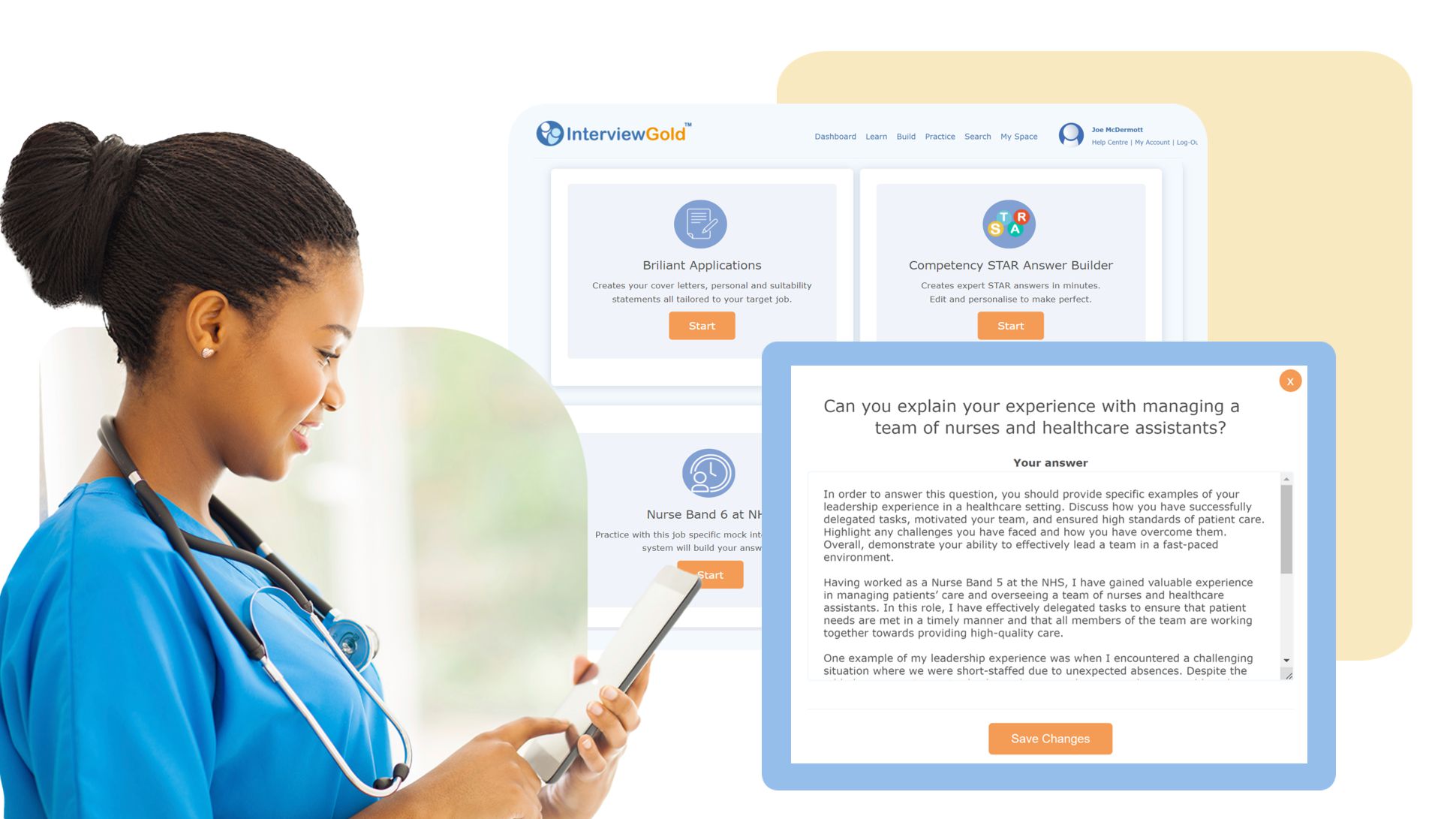
Get instant access to our easy InterviewGold online system and get the Nursing job you want.
You will get expert interview answers created for you by the powerful ANSWER BUILDER including STAR competency examples.
Boost your interview skills with Nursing mock interviews with accurate questions and expert interview answers.
PLUS lots of great advice and features, making sure you are 100% confident and ready to get your target Nursing job.